
How to Make Hyper-Realistic Halloween Eyeball Jelly Cups Using Agar Agar

 Halloween Food & Parties
Layered agar agar creates sharp, hyper-realistic edible eyeballs that remain structurally firm at room temperature.
Creating hyper-realistic Halloween eyeball jelly cups requires a specific gelling agent, deliberate temperature control, and a reverse-layering technique to achieve razor-sharp pupils and irises. By relying on plant-based agar agar rather than traditional gelatin, these eerie party cups achieve an opaque, firm finish that holds its shape entirely at room temperature without melting into a murky pool.
Most home cooks struggle with bleeding colors and distorted layers because standard gelatin demands long cooling times and liquefies easily under ambient heat. Agar, a hydrocolloid derived from red algae, behaves completely differently by setting firmly within minutes at around 95°F to 104°F. Understanding this distinct setting mechanism is the secret to building crisp, multi-colored optical illusions in individual dessert cups.
The Science of Agar Agar: Why Gelatin Fails for Detailed Layering
Standard animal-derived gelatin sets slowly through refrigeration and forms a soft, thermoreversible bond that collapses when exposed to room temperature. In contrast, agar agar creates a firm, brittle, and heat-stable gel matrix. This structural integrity allows bakers to pour warm layers directly over semi-set bases without dissolving the underlying details.
Because agar sets rapidly as the liquid cools, it enables rapid assembly of microscopic details like pupils and irises. The physical properties also eliminate the rubbery chew associated with over-concentrated gelatin, yielding a clean, snap-like bite that works exceptionally well for novelty chilled desserts.
The most critical error when working with agar is failing to reach a full boil; the powder must be actively simmered to fully hydrate and unlock its structural gelling capacity.
Traditional culinary myths often claim that agar and gelatin can be substituted at a simple 1:1 ratio. In scientific reality, agar possesses roughly three to four times the gelling strength of standard commercial gelatin. Substituting equal weights results in an unpalatable, rock-hard block rather than an authentic, glossy eyeball texture.
Component Ratios and Material Specifications
Formulating distinct optical layers requires balancing transparency against solid opacity. The deep center of the pupil demands absolute darkness, the iris needs vibrant translucent or milky color, and the sclera—the white of the eye—requires complete opacity to sell the illusion.
| Eyeball Component | Recommended Liquid Base |
|---|---|
| Pupil Core | Dark fruit juice, activated charcoal suspension, or concentrated black food dye |
| Iris Ring | Clear apple juice, kiwi syrup, or colored sports drinks |
| Opaque Sclera | Coconut milk, sweetened condensed milk, or oat milk |
| Outer Cornea (Optional) | Filtered water sweetened with simple syrup and citric acid |
Step-by-Step Construction of Layered Eyeball Jelly Cups
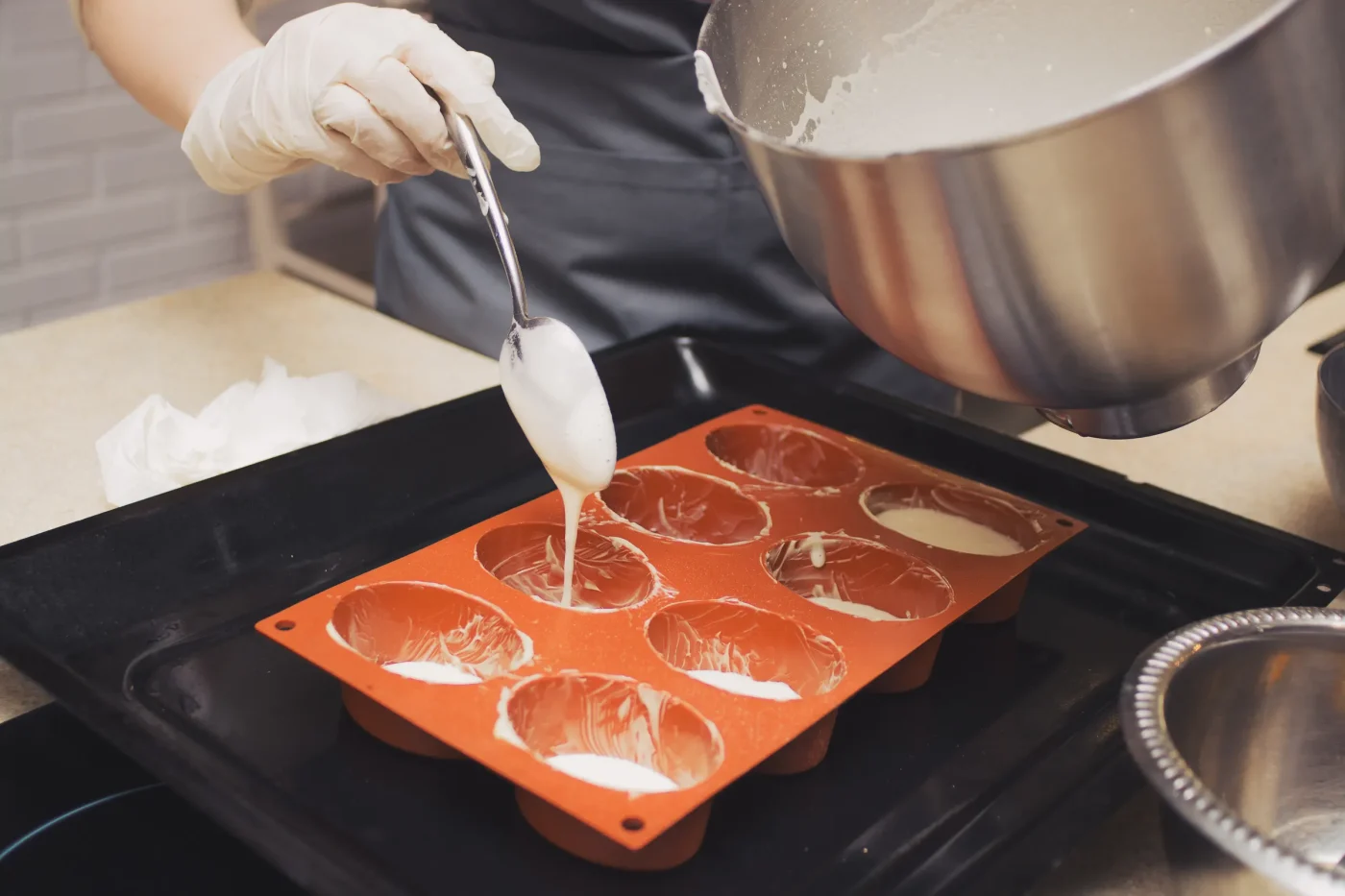
Achieving realistic anatomical depth requires building the dessert upside-down inside small hemispherical molds, silicone ice trays, or rounded shot glasses. Once fully set, the entire piece is inverted into clear individual serving cups or suspended within an outer clear sphere.
- Hydrate and Activate the Agar: Whisk powdered agar agar into room-temperature water or juice at a concentration of approximately 1 teaspoon of powder per 1 cup of liquid. Bring the mixture to an active rolling boil over medium heat, stirring continuously for a full 2 to 3 minutes to activate the polysaccharides.
- Cast the Center Pupil: Color a small portion of the boiling agar base with deep black food coloring. Using a fine culinary dropper, deposit small, uniform drops (about 5 to 8 millimeters wide) into the bottom center of each mold cavity. Allow them to set at room temperature for roughly 3 minutes until firm to the touch.
- Layer the Colored Iris: Prepare a colored batch—such as emerald green, icy blue, or amber—and cool it slightly to roughly 120°F so it does not remelt the pupil. Gently drop a slightly larger ring of this liquid directly over the hardened pupil dot, expanding the diameter to create the iris edge.
- Pour the Sclera: Simmer coconut milk or sweetened cream with activated agar to produce a stark white mixture. Once cooled to a lukewarm, pourable state, fill the remainder of the mold cavity to form the bulk of the eyeball mass.
- Unmold and Stage: Chill the completed cups for 20 minutes to ensure core stabilization. Gently release the eyeballs from their molds and position them right-side up inside clear dessert cups, finishing with a drizzle of red raspberry coulis to mimic ruptured capillaries.
Troubleshooting Syneresis and Separation
A common hurdle with agar-based confectionery is syneresis—the spontaneous weeping of water from the gel network as it contracts. To minimize fluid pooling inside the serving cups, avoid freezing the jelly, as ice crystal formation permanently fractures the agar structure. Storing the finished cups covered in a standard refrigerator maintains structural elasticity until service.
Another risk during assembly is layer separation, where the iris detaches cleanly from the white sclera upon unmolding. This occurs when the bottom layer becomes completely cold and dry before the next layer is poured. Pouring subsequent layers while the preceding layer is firm yet still slightly warm creates an unbreakable molecular bond across the interface.
💡 Prep your silicone molds on a level baking sheet to ensure every pupil settles perfectly in the geometric center of the dome.
🔍 Test a single droplet on a chilled plate before pouring your main batches to confirm your agar concentration achieves the desired firmness.
📌 Explore different natural colorings like blue spirulina or matcha powder to customize eerie iris variations for your guests.
👇 Share your experiences with us and leave your thoughts in the comments below on how your layered creations turned out!