
Three Hidden Cosmic Phantoms Uncovered in Cassiopeia After 100-Hour Deep-Sky Survey

 Costumes & Makeup
Three Hidden Cosmic Phantoms Uncovered in Cassiopeia After 100-Hour Deep-Sky Survey
A grueling 100 hours of observation has officially exposed three previously unseen cosmic phantoms drifting in deep space, identified simply as Object 1, Object 2, and Object 3. Positioned deep inside the northern constellation Cassiopeia, these delicate structures were uncovered using specialized narrowband filtration to register faint glowing signatures of ionized oxygen that traditional optical surveys completely overlooked.
The discovery adds an unexpected chapter to one of the night sky’s most thoroughly photographed regions. Astrophotographers collaborating via Starfront Observatories—Louis Leroux-Géré, Thibault Rouillée, Vincent Martin, and Cédric de Decker—pieced together the massive exposure time to trace faint blue silhouettes alongside the region’s famous glowing apparitions, IC 59 and IC 63.
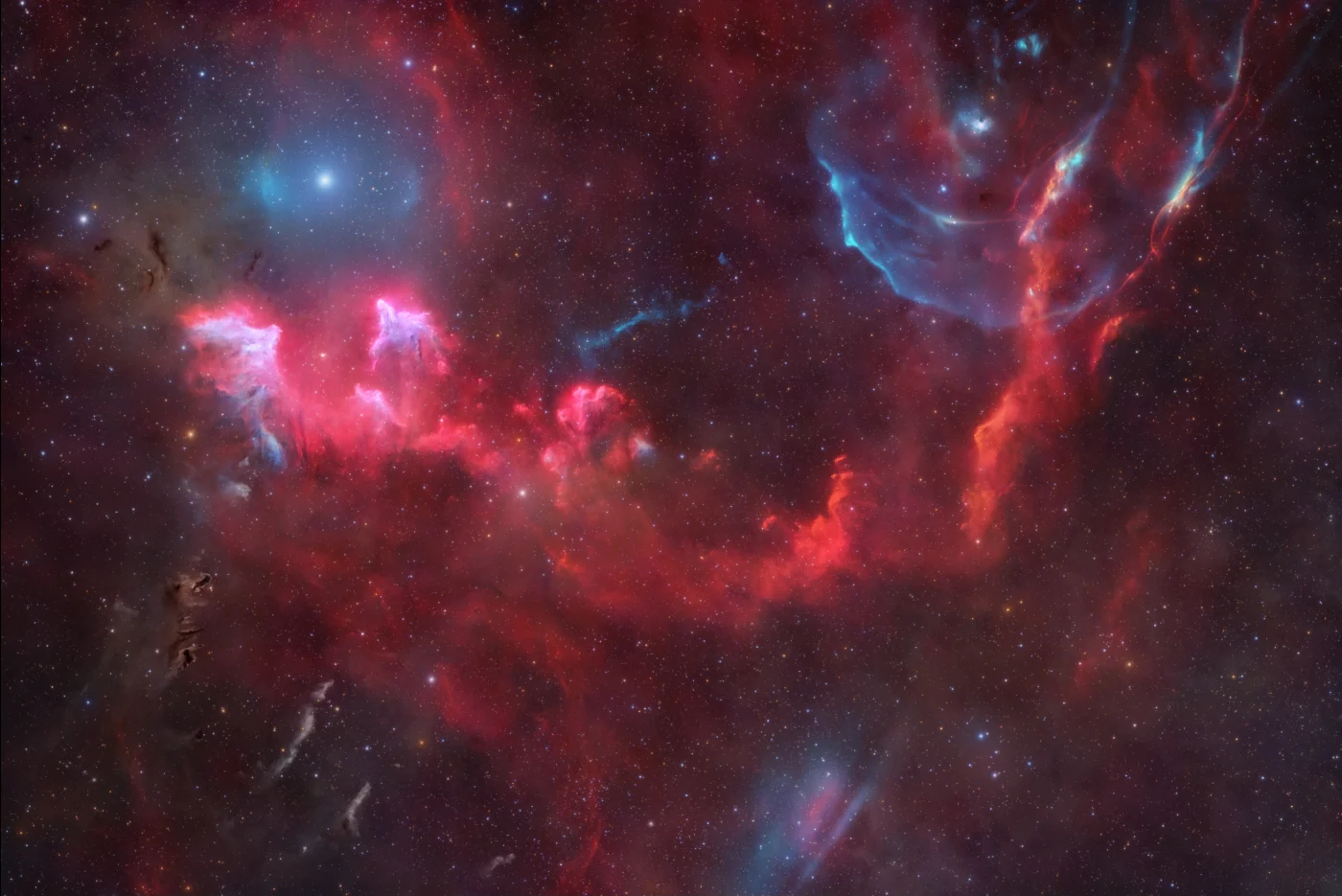
The sky is speckled with stars, featuring bright tufts of emission nebulae tracing across the equator alongside arcs of ionized oxygen emission.
Behind the Glow: Energetic Physics of the Cassiopeia Nebulae
The celestial sector is dominated by γ Cassiopeiae (Gamma Cassiopeiae), an intensely energetic multi-star system pouring high-energy ultraviolet radiation into the surrounding interstellar medium. This radiation drives the physical processes behind the well-known Ghosts in Cassiopeia:
- IC 63 and IC 59: Massive hydrogen clouds that absorb extreme ultraviolet photons and fluoresce with characteristic deep red emission.
- Interstellar Dust Veils: Clouds that reflect and scatter the blue-white starlight emitted by the central stellar driver.
- Ionized Oxygen Structures: The newly discovered trio exhibiting pale blue signatures isolated strictly through narrowband optical filters.
While hydrogen emissions trace broad interstellar filaments with ease, capturing ionized oxygen requires immense exposure times due to its tenuous spatial density in cold cosmic gas. But how did these newly documented gas clouds become energized in the first place?
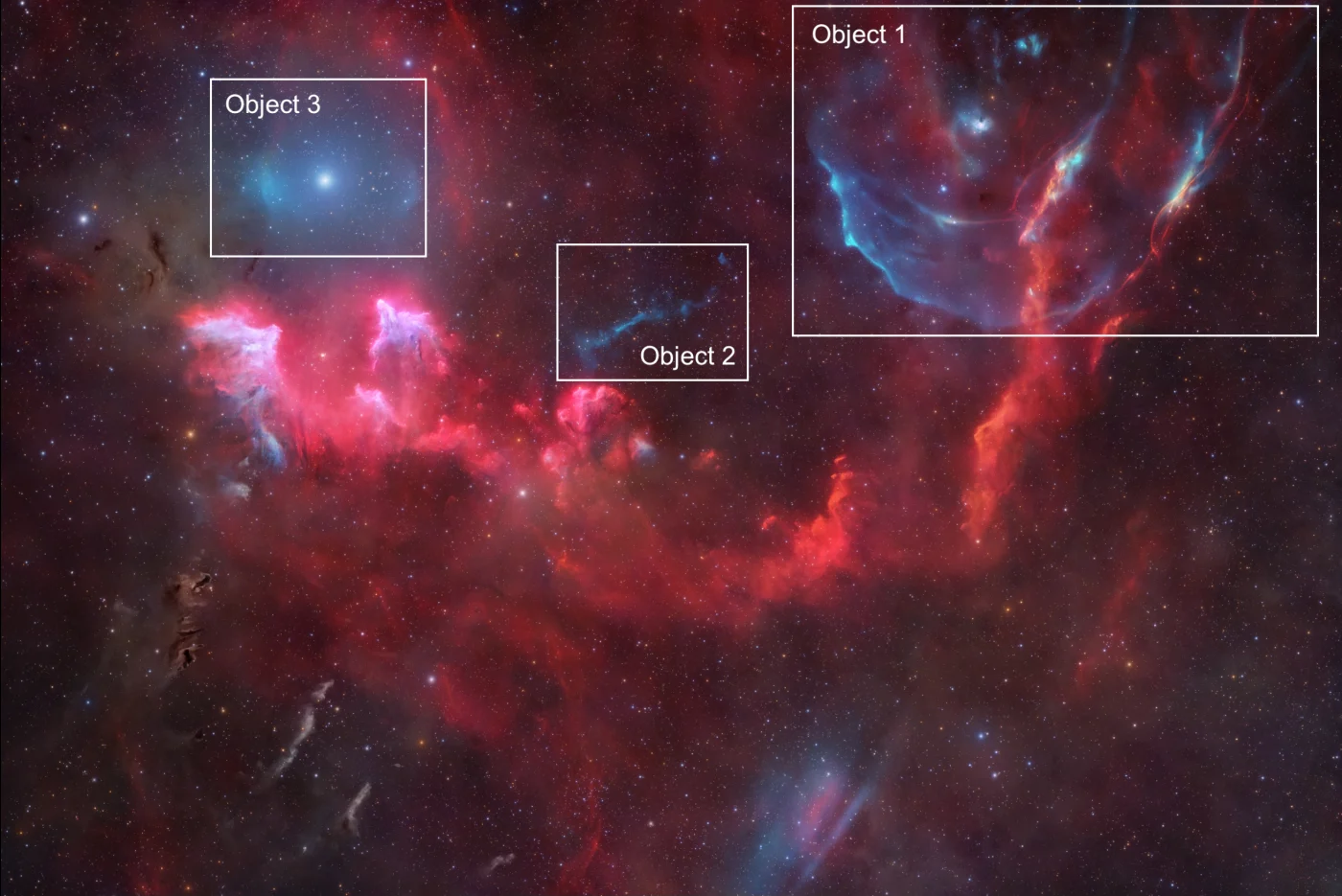
The sky is speckled with stars, with annotated labels pointing out the three new objects visible in oxygen emission.
Bow Shocks and Planetary Remnants: The Leading Hypotheses
Astrophysicists are examining two distinct mechanisms to account for the presence of these oxygen-rich apparitions. The first relies on the dynamic movement of the multi-star system itself plow-tailing through deep space.
Ionization signatures in diffuse gas clouds can emerge either from the violent compression of interstellar material or through the lingering thermal footprint of a dying stellar core.
Much like water piling up at the prow of an ocean-going vessel, γ Cassiopeiae is cutting through cold interstellar gas and dust. This rapid transit creates a colossal cosmic bow shock. Under this interpretation, Object 3 represents compressed, frictionally heated oxygen gas concentrated along the front edge of this shockwave boundary.
The Search for a Hidden White Dwarf
A separate process may explain Object 1. Researchers theorize that this specific formation could be an uncataloged planetary nebula produced by the outer layers of an aging star expelled into space. For this hypothesis to stand up to scrutiny, observational teams must confirm the presence of a central white dwarf acting as the remnant ionizing engine.
| Identified Feature | Scientific Characteristic |
|---|---|
| Primary Illuminator | γ Cassiopeiae (Multi-star system) |
| IC 59 & IC 63 | Hydrogen emission (red) & dust reflection (blue-white) |
| Object 1 | Ionized oxygen candidate planetary nebula |
| Object 3 | Probable compressed bow shock from stellar movement |
| Total Observation Time | 100 cumulative hours |
Busting the Deep-Space Observation Myth
A frequent misconception in modern amateur astronomy suggests that visible light imaging captures the total physical structure of deep-sky clouds. In reality, standard RGB broadband imaging frequently drowns out dim gas interactions in a wash of stellar scatter.
Without targeted narrowband isolation of single wavelengths—such as the double-ionized oxygen spectrum—these three celestial objects remain utterly invisible against the cosmic background. The origins of these astronomical ghosts remain active puzzles waiting for high-resolution spectroscopy to confirm their definitive physical nature.
💡 Track upcoming astronomical surveys as follow-up observations work to identify candidate white dwarf remnants near Object 1.
🔍 Examine deep-sky catalogs to understand how narrowband filtration techniques are fundamentally reshaping modern amateur discoveries.
👇 Leave your thoughts in the comments below on whether Object 1 will turn out to be a planetary nebula or another stellar shockwave!